Once again I've managed to get well behind on blogging my all grain brewdays. I don't know where the time goes. I've had a busy few weeks with a couple of short breaks away and then some visitors came to stay so brewing has been sporadic to say the least.
I've just finished Ag#25 today, the fourth brew of a superb beer based on GWs Double Dragon. I've modified it somewhat so it is only loosely based on the original.
Since my last brewday post (AG#19) I've brewed the following beers.
Own recipe Cascade Gold AG#20 - bittered with Magnum hops (12.7% AA) and late hopped with Cascade, post boil steep hopped with more Cascade and after primary fermentation, dry hopped with even more Cascade - the result, a golden belter of a beer 5.5%abv and nicely sessionable - it didn't last long and was a definite fave with friends and family.
Double Dragon AG#21 (3rd batch) - This vanishes rapidly, another fave with friends and family.
Own Recipe Mocha Toasted Oatmeal Stout AG#22 - Challenger and Target for bittering, no aroma hops at all. Pale Malt, Munich, Amber, Roasted barley, Chocolate malt and home toasted oatmeal. 6 shots of freshly brewed espresso at the end of the boil. - the result, 4.5%abv, heavenly coffee and chocolate stout. Smooth and creamy and a definite re-brew in order.
Own recipe, Lathiere Blonde (pronounced Latt-ee-err) AG#23 named after the hamlet we live in and a hybrid of traditional UK hops and Cascade - This is only just bottled with 20l racked off to a plastic tank to condition ready to be chilled (my theory to preserve the co2 from the light priming I gave it) and racked off into bag in a box (kept cold) for serving but it's smelling gooood.
Own recipe Nelson Sauvin single hopped IPA or NZPA perhaps. First time using Nelson Sauvin and I must say I'm impressed. Lovely citrus, grapefruit reminiscent of some US hops but with an underlying tropical aroma to it, not sure what. Difficult to describe. I only brewed this the day before yesterday but it's smelling super in the FV.
I'm not going to do any write ups as far as I can see at the moment for these last few brews. They've all been pretty uneventful and not really any different to previous brewdays.
Showing posts with label brew days. Show all posts
Showing posts with label brew days. Show all posts
Sunday, August 5, 2012


Monday, May 21, 2012
East Kent Blonde - Own recipe all grain pale bitter
I fancied something simple and session-able with the summer coming up (I wish someone would remind the rain gods of this) but also with a bit of interest in the nose and taste. Something quaff-able but with a bit of, "hmmmm what's that?" about it.
I went for pale malt, pale crystal and tried just using flaked wheat instead of torrified to see what sort of head retention it gave. I've been reading that flaked wheat behaves the same as torrified but without the flavours torrified can sometimes add. It was absolutely nothing to do with opening the wrong bag and not realising until it had been tipped into the malt bucket...
I also wanted the classic combination of East Kent Golding and Fuggle hops with some target chucked in for its higher alpha acid content for bitterness.
I also figured I'd have a go at caramelizing some of the first run sweet wort after reading a thread on Jim's Beer Kit about the toffee, caramel and vanilla notes this process can bring to a beer.
End result, v nice. Everything I'd aimed for pretty much but I ended up slightly over target OG so from what was meant to be 3.9% abv beer I ended up with a 4.1% - still a lot more session-able than the typical 5.5 to 7% brews.
This is also one I plan to have on hand pull for our summer garden party.
Target brew length: 25l (got 26l)
Mash liquor: 11l
Total liquor: 38l
Mash time: 90 minutes
Boil time: 90 minutes
Fermentables:
Pale malt: 4,170g
Pale crystal: 100g
Flaked wheat (ahem): 150g
Bittering and Late Hops:
Target (12.6%AA) - 11g @ 90 minutes
Fuggles - 11g @ 90 minutes (old bag, pre MaltMiller supplier so %AA unknown)
Fuggles - 20g @ 30 minutes
East Kent Goldings (4.96%AA) - 15g @ 10 mins
Aroma Hops:
East Kent Goldings (4.96%AA): 20g @ 80C steep for 30 minutes
Fuggles (3.81% AA) - 25g @ 80C steep for 30 minutes
Not many pics, I was using my phone camera as my Mrs had pinched my camera to take photos of her handmade bags that she sells on Etsy.
Next time I brew this, all bittering hops in at 90 mins. Some additional EKG and Fuggles in at 10 minutes and then slightly more EKG and Fuggles in for the 80C steep.
It was bitter, it was hoppy but I think (possibly due to the caramel/vanilla notes) the bitterness and hop aroma can stand to go up a bit.
 |
| Ooops, half way down the first sampler I remembered to take a piccy. Clearest pale beer I've brewed to date. |
I also wanted the classic combination of East Kent Golding and Fuggle hops with some target chucked in for its higher alpha acid content for bitterness.
I also figured I'd have a go at caramelizing some of the first run sweet wort after reading a thread on Jim's Beer Kit about the toffee, caramel and vanilla notes this process can bring to a beer.
End result, v nice. Everything I'd aimed for pretty much but I ended up slightly over target OG so from what was meant to be 3.9% abv beer I ended up with a 4.1% - still a lot more session-able than the typical 5.5 to 7% brews.
This is also one I plan to have on hand pull for our summer garden party.
Target brew length: 25l (got 26l)
Mash liquor: 11l
Total liquor: 38l
Mash time: 90 minutes
Boil time: 90 minutes
Fermentables:
Pale malt: 4,170g
Pale crystal: 100g
Flaked wheat (ahem): 150g
Bittering and Late Hops:
Target (12.6%AA) - 11g @ 90 minutes
Fuggles - 11g @ 90 minutes (old bag, pre MaltMiller supplier so %AA unknown)
Fuggles - 20g @ 30 minutes
East Kent Goldings (4.96%AA) - 15g @ 10 mins
Aroma Hops:
East Kent Goldings (4.96%AA): 20g @ 80C steep for 30 minutes
Fuggles (3.81% AA) - 25g @ 80C steep for 30 minutes
Not many pics, I was using my phone camera as my Mrs had pinched my camera to take photos of her handmade bags that she sells on Etsy.
 |
| As you can see (bottom left) flaked wheat looks nothing like torrified wheat... Not sure what I was thinking but it worked out ok in the end with a bloody nice, crisp pinter. Just need a bloody nice summer to finally appear now. |
 |
| First runnings taken in my blurred foreground, sharp background photography style. FFS! |
 |
| It was looking a little dark in the bucket even once I was sparging but it soon paled down/up. |
 |
| 1 litre of first run sweet wort boiling down next to the main boil... |
 |
| Reduced to 250ml and a thick syrupy gloop. During this time the smells were absolute toffee and vanilla. Nice! |
 |
| Chiller in and last hops etc etc yawn usual stuff |
 |
| Shite heading for the compost bin. |
It was bitter, it was hoppy but I think (possibly due to the caramel/vanilla notes) the bitterness and hop aroma can stand to go up a bit.
Tuesday, October 25, 2011
AG#6 All Grain Everards Tiger (ish)
I brewed this beer during the same weekend as my previously posted All Grain Winter Warmer. This recipe is based on the all grain Everards Tiger recipe taken from page 145 of Graham Walker's Brew Your Own British Real Ale. If you don't already have this book, I highly recommend it!!!
I say that this brew is based on the recipe as I chose to replace the 12g of Black malt in the recipe with some Amber malt instead. Why? I found that the addition of the black malt in my all grain, home brew Banks Bitter made the finished beer a little too dark. I also have a surplus of amber malt and so I thought I could kill two birds with one stone and use up some of my amber malt whilst adding some darker colour but not too much. I also like the subtle, biscuity flavours the amber malt brings to the beer.
I also (accidentally) added more Crystal malt and Torrefied wheat than the recipe required, I was getting some weight fluctuations that I didn't spot initially and had to put new batteries in my scales. Too late to remove and reweigh as I had already tipped the grains into the bulk of the pale malt... Next time I shall weigh the grains into separate containers before mixing.
Brewday, Sunday16th October, target volume 23l.
The grain bill:

Again, the brewday went without any major problems, my equipment is behaving and performing well.
The mash schedule: 10 litres of liquor at 66C for 90 minutes - again my mash tun didn't lose a single degree :) HLT temp was 75C giving me a strike temp in the pre heated mash tun (kettle of boiling water for 20 minutes) of 72C. After the addition of the grains and doughing in I hit the target of 66C bang on.
Unfortunately the yeast starter I had made from some yeast reclaimed from a previous brew didn't appear to get going and so I chose to bin it rather than risk using it. I had one pack of Wyeast 1968 London that I was saving for an ESB I plan to brew soon so I used that.
Target gravity was 1041 but I got 1045. I'm still not up to speed with calculating efficiency but I keep achieving higher gravities. I can only put this down to my mash tun being very efficient and extracting more fermentable sugars from the malted grains. I'm not overly concerned at this point, I'm far from being ready to consider selling my brews, as a slightly stronger beer isn't really a bad thing.
Here are the piccies.

First run off from the mash tun, I'm liking the colour. Note, I ran a couple of litres off into a jug first until the grain bed settled and the wort began to run clearer.
From the initial 10 litres of hot liquor for the mash I extracted about 7 litres of wort prior to sparging.
I heated the hot liquor tank to 80C for the sparge and slowly sparged the grain bed to end up with 25 litres of wort with a gravity around 1039 bearing in mind this lower gravity is pre boil and pre addition of 200g of sugar during the boil. Unable to calculate exactly what the boil and sugar was going to add to the gravity I wasn't sure how much water to add to the wort pre boil.
From previous experience of the evaporation losses, in order to end up with my target of 23 litres I'd need to start the boil with around 30 to 31 litres... I topped up to 30 litres and hoped the gravity would climb to the target 1041 with the evaporation losses and sugar taken into account.

Approaching boil, the hot break material begins to form. As before I skimmed the surface froth away as it formed prior to reaching the rolling boil.

Some of the skimmed surface break material... nice isn't it?

Getting down to business now with a vigorous boil, in go the bittering hops - 31g Challenger. This is my first brew using Challenger and the smell was very nice indeed. I have yet to find hops I don't love the smell of when they go in the boil.

As this was quite an uneventful, other than ending up with 23l of lovely beer, I haven't gone mad on photos. they are all beginning to look a bit samey. You can see the cold break material starting to clump together in the photo above as my home made wort chiller brings the temp down to 30C after the boil. The aroma hops, 20g Fuggles, went into the brew ten minutes before end of boil.
This addition of hops towards the end or after the boil is to me a bit of a pain when using an immersion chiller like above. As the chiller has to go into the boiling wort 15 or so minutes before then end of boil to be sterilized, the (end of boil) hops go in afterwards and tend to get all caught up in the coils of the chiller as they roll around. Not bad to begin with but they gradually collect together and rise up out of the boiling wort. I keep tapping them back in with my brewing spoon but, it's a bit of a pain in the ass.

The hopped sweet wort has been chilled and can be seen running off from the copper into the fermenter.
I pitched the yeast and as with my previous use of wyeast smack pack yeasts, nothing bloody happened for two days! I was beginning to worry the pack had not been viable - I followed the instructions to the T - when finally the brew burst into life and began to ferment.
A day or so later my order of bottles arrived along with some airlocks and grommets so I drilled the fermenter lid and fitted an airlock to it. As I write this, it's still glugging away like a goodun and the gravity is taking longer than normal to drop. This might be due to the slightly lower temperatures now or it might just be the yeast was struggling to get going. So even with my delayed posting, there's no photos of the finished beer just yet.
On the subject of temperatures I am looking to, in the not too distant future, convert and old fridge by way of an external controller with a probe in the beer and a tube heater fitted internally into a temperature controlled fermenting cabinet. More on that soon...
I am about to open a bottle of my Banks Bitter that I have been enjoying recently and, weather permitting, take a nice photo to post later on.
I say that this brew is based on the recipe as I chose to replace the 12g of Black malt in the recipe with some Amber malt instead. Why? I found that the addition of the black malt in my all grain, home brew Banks Bitter made the finished beer a little too dark. I also have a surplus of amber malt and so I thought I could kill two birds with one stone and use up some of my amber malt whilst adding some darker colour but not too much. I also like the subtle, biscuity flavours the amber malt brings to the beer.
I also (accidentally) added more Crystal malt and Torrefied wheat than the recipe required, I was getting some weight fluctuations that I didn't spot initially and had to put new batteries in my scales. Too late to remove and reweigh as I had already tipped the grains into the bulk of the pale malt... Next time I shall weigh the grains into separate containers before mixing.
Brewday, Sunday16th October, target volume 23l.
The grain bill:
- Pale malt: 3400g
- Crystal malt: 386g
- Amber malt: 200g
- Torrefied wheat: 197g
- 31g Challenger in at start of boil (90 mins)
- 20g Fuggles in during the last 10 minutes of the boil.
200g white sugar to go in approx half way through the boil and as with my last couple of brews I rehydrated the Irish Moss which was added in the last 10 minutes of the boil.
Before bottling I will also be dry hopping with a few cones of Goldings.
Again, the brewday went without any major problems, my equipment is behaving and performing well.
The mash schedule: 10 litres of liquor at 66C for 90 minutes - again my mash tun didn't lose a single degree :) HLT temp was 75C giving me a strike temp in the pre heated mash tun (kettle of boiling water for 20 minutes) of 72C. After the addition of the grains and doughing in I hit the target of 66C bang on.
Unfortunately the yeast starter I had made from some yeast reclaimed from a previous brew didn't appear to get going and so I chose to bin it rather than risk using it. I had one pack of Wyeast 1968 London that I was saving for an ESB I plan to brew soon so I used that.
Target gravity was 1041 but I got 1045. I'm still not up to speed with calculating efficiency but I keep achieving higher gravities. I can only put this down to my mash tun being very efficient and extracting more fermentable sugars from the malted grains. I'm not overly concerned at this point, I'm far from being ready to consider selling my brews, as a slightly stronger beer isn't really a bad thing.
Here are the piccies.
First run off from the mash tun, I'm liking the colour. Note, I ran a couple of litres off into a jug first until the grain bed settled and the wort began to run clearer.
From the initial 10 litres of hot liquor for the mash I extracted about 7 litres of wort prior to sparging.
I heated the hot liquor tank to 80C for the sparge and slowly sparged the grain bed to end up with 25 litres of wort with a gravity around 1039 bearing in mind this lower gravity is pre boil and pre addition of 200g of sugar during the boil. Unable to calculate exactly what the boil and sugar was going to add to the gravity I wasn't sure how much water to add to the wort pre boil.
From previous experience of the evaporation losses, in order to end up with my target of 23 litres I'd need to start the boil with around 30 to 31 litres... I topped up to 30 litres and hoped the gravity would climb to the target 1041 with the evaporation losses and sugar taken into account.
Approaching boil, the hot break material begins to form. As before I skimmed the surface froth away as it formed prior to reaching the rolling boil.
Some of the skimmed surface break material... nice isn't it?
Getting down to business now with a vigorous boil, in go the bittering hops - 31g Challenger. This is my first brew using Challenger and the smell was very nice indeed. I have yet to find hops I don't love the smell of when they go in the boil.
As this was quite an uneventful, other than ending up with 23l of lovely beer, I haven't gone mad on photos. they are all beginning to look a bit samey. You can see the cold break material starting to clump together in the photo above as my home made wort chiller brings the temp down to 30C after the boil. The aroma hops, 20g Fuggles, went into the brew ten minutes before end of boil.
This addition of hops towards the end or after the boil is to me a bit of a pain when using an immersion chiller like above. As the chiller has to go into the boiling wort 15 or so minutes before then end of boil to be sterilized, the (end of boil) hops go in afterwards and tend to get all caught up in the coils of the chiller as they roll around. Not bad to begin with but they gradually collect together and rise up out of the boiling wort. I keep tapping them back in with my brewing spoon but, it's a bit of a pain in the ass.
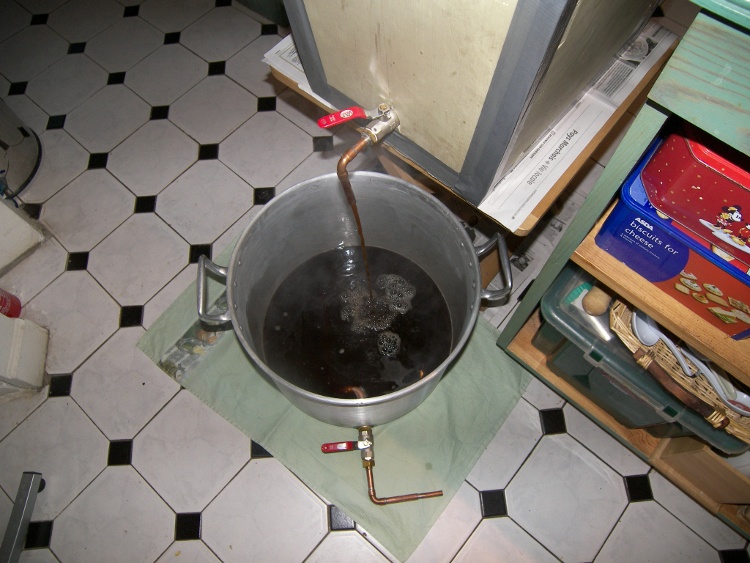
The hopped sweet wort has been chilled and can be seen running off from the copper into the fermenter.
I pitched the yeast and as with my previous use of wyeast smack pack yeasts, nothing bloody happened for two days! I was beginning to worry the pack had not been viable - I followed the instructions to the T - when finally the brew burst into life and began to ferment.
A day or so later my order of bottles arrived along with some airlocks and grommets so I drilled the fermenter lid and fitted an airlock to it. As I write this, it's still glugging away like a goodun and the gravity is taking longer than normal to drop. This might be due to the slightly lower temperatures now or it might just be the yeast was struggling to get going. So even with my delayed posting, there's no photos of the finished beer just yet.
On the subject of temperatures I am looking to, in the not too distant future, convert and old fridge by way of an external controller with a probe in the beer and a tube heater fitted internally into a temperature controlled fermenting cabinet. More on that soon...
I am about to open a bottle of my Banks Bitter that I have been enjoying recently and, weather permitting, take a nice photo to post later on.
Monday, October 17, 2011
AG#5 All Grain Christmas Beer / Winter Warmer
With winter approaching way too quickly for my liking I have got to thinking about getting the Chritsmas brew on the go. I'm wanting something with all the traditional Christmassy flavours ie oranges, chestnuts, cinnamon and cloves but not a beer that's too strong. I don't mind the occasional head banger but I'm looking for something that allows everyone to enjoy a few, hearty glasses full during the festive season. Around 5% abv will do me.
Brew days, weekend of the 15th and 16th October. A late start for me due to some errands earlier in the day. I didn't get the HLT warming up until 16:45.
In the end I settled on:
Mashed for 60 minutes with 10l liquor at 65C
Sparged slowly for 30 mins with 20l liquor at 79C HLT with 62C run off from Mash Tun
The taste of the run off remained sweet until the very end this time. Usually in the past I've stopped sparging when the flavour has gone and the run off is almost colourless. I think I could have ended up with an additional few litres of beer out of this brew but I currently don't have the fermenters for it.
60 minute boil - I have been doing 90 minute mash and boil but the book this recipe is based on calls for 60 mins each... we'll see. The book also didn't give any idea of target OG or FG so it's a bit of guesswork as to if the brew runs on track. Based on the approx ABV given in the book I aimed for a target gravity after the boil of 1048 to 1050 - I got 1048.
As with my last brew I skimmed the hot break material away as it built up prior to reaching the rolling boil. I'm sure this makes a difference to the clarity of the final hopped wort as my last beer and this one (as I later found when running it off to the fermenter) are noticeably clearer to begin with than my others. It also makes cleaning the boiler easier afterwards as there isn't so much baked on gunk around the top of the pan.
Bittering Hops: (in at 60 mins remaining)
Roasted chestnuts (360g peeled and chopped up) in at 15 minutes remaining.
Spice mixture in at 10 minutes remaining along with the rehydrated Irish Moss copper finings.
The spice ingredients were mixed together the evening before in a small tub and allowed to melange together.
Post Boil Aroma Hops in at 10 minutes after the boil finished:
Brew days, weekend of the 15th and 16th October. A late start for me due to some errands earlier in the day. I didn't get the HLT warming up until 16:45.
In the end I settled on:
 |
| The grain bill and sad Keanu for my Winter Warmer |
- 3,800g Pale malt
- 270g Crystal malt
- 230g Amber malt
- 50g Roasted barley
- 110g Flaked barley
- 200g Brown sugar - this was added to the recipe by myself during the brew as it began to come clear the gravity was going to end up lower than the book made out.
Mashed for 60 minutes with 10l liquor at 65C
 |
| First runnings from the mash tun |
 |
| Sparging |
60 minute boil - I have been doing 90 minute mash and boil but the book this recipe is based on calls for 60 mins each... we'll see. The book also didn't give any idea of target OG or FG so it's a bit of guesswork as to if the brew runs on track. Based on the approx ABV given in the book I aimed for a target gravity after the boil of 1048 to 1050 - I got 1048.
 |
| Skimming the hot break material from the wort as it approaches the boil. |
Bittering Hops: (in at 60 mins remaining)
 |
| Nice vigourous boil and in go the bittering hops. |
- 6g Goldings
- 20g Northern Brewer
- 7g Styrian Goldings
Roasted chestnuts (360g peeled and chopped up) in at 15 minutes remaining.
 |
| 360g of roasted chestnuts, peeled and chopped up. Not sure if 360g is enough... |
The spice ingredients were mixed together the evening before in a small tub and allowed to melange together.
 |
| The spice and orange mix for this winter warmer. Also in shot, a pint of my Olde Wizard, All Grain Stout |
- Zest of four med oranges - don't zest down to the bitter white pith, just take the surface off. Wash the oranges first, some are waxed, we don't want that.
- 1 stick of cinnamon, approx 50mm long snapped in two
- 3 cloves
- 1 teaspoon of coriander seeds
Post Boil Aroma Hops in at 10 minutes after the boil finished:
 |
| Post boil hops added. |
- 8g Goldings
- 14g Styrian Goldings
- 12g Bramling Cross
Something I did differently this time (partly due to the lateness of getting started but partly due to a theory I had, read on below) I didn't use the wort chiller opting instead to cover up the finished, hopped wort and allowing it to cool overnight.
I popped the lid onto the boiler and left it all to cool down overnight. I've been reading about oils from chestnuts and the orange zest not only imparting flavour and aroma but also causing problems with the beers head retention. My thoughts were that if I allow the hopped wort to cool overnight the oils can do their thing and hopefully float to the surface. As my system drains via a filter from the bottom of the pan the oils should be kept away from getting into the Fermenter... this I do not know to be a fact.
The following morning the wort temperature was still at 35C, too high to pitch the yeast so I ran the wort off into the FV, covered it up to continue cooling while I cleaned up and got ready for my second brew of this weekend which I will be posting shortly.
When fermentation had taken the gravity down to 1,009 I racked off the beer into my secondary fermenting bin and dry hopped with a light handful of Bramling Cross hops. A sneaky taste before sealing the lid up and fitting an airlock gave me a subtle but pleasant Christmassy flavour. Great colour too and looking like it's clearing down ok.
UPDATE 20/10/11:
I have now bottled this beer and it's smelling, tasting and looking very good. All Grain Christmas Beer Bottled.
When fermentation had taken the gravity down to 1,009 I racked off the beer into my secondary fermenting bin and dry hopped with a light handful of Bramling Cross hops. A sneaky taste before sealing the lid up and fitting an airlock gave me a subtle but pleasant Christmassy flavour. Great colour too and looking like it's clearing down ok.
UPDATE 20/10/11:
I have now bottled this beer and it's smelling, tasting and looking very good. All Grain Christmas Beer Bottled.
Thursday, October 6, 2011
Brewdays - #4 All Grain Banks Bitter
I'm a bit late getting this brew day blogged due to getting chimneys cleaned and fitted out with stainless steel flexible flue liners, wood burners tidied up, firewood sorted ready for winter and rehearsing with my new band (I play drums).
Brewday was 22nd Sept and the recipe is from page 114 of Graham Wheeler's splendid all grain home brewing recipe book, Brew Your Own British Real Ale.
The only modification to my brewing equipment has been the addition of some quick fit hose connectors and a length of brand new hose pipe for my home made wort chiller.
To open with here's the obligatory grain shot. Again, I tried to jazz it up a little by making a smiley face with the grains but it didn't turn out too well.

This wasn't the most taxing of brews although being a newbie to this, I'm not exactly looking for problems. The day went very well all in all and I ended up with 23 litres of very nice smelling hopped wort in the FV.

I pre heated the mash tun again using just a kettle full of boiling water and shut the lid while I prepared a few last minute bits and bobs. After about 10 or 15 minutes I tipped out the boiling water and began to fill the mash tun with 10 litres of hot liqour at 74C (grain temp was 22C), my target mash temp was 67C which I hit bang on when I added the grist and doughed in.

Feeling a lot more relaxed this time, a couple of brew days under the belt makes a lot of difference, I even managed to sneak away and get a big old bacon and mushroom butty on the go. Argh that was the last pack of English bacon left in the freezer. When we have visitors who drive here rather than fly we ask them to bring a few packs of good olde English bacon with them. the French stuff is nice in its own way but it's different and sometimes you just can't beat a proper bacon butty.
The mash (6pH) was left for 90 minutes.

First runnings from the mash tun was very clear after the first couple of litres. It was looking darker than my memory of Banks Bitter however and I remember thinking at the time - when reading the recipe - that there seemed a fair amount of black malt (38g) for such a light coloured beer. (As this is a late post of the brewday I have since bottled and tasted this beer and it is darker than Banks Bitter. Next time I'll half the black malt)

Sparging bar worked really well again, I'm very happy with it. By the time I turned off the sparge liquor (80C) I had 27 litres of lovely wort. Based on my previous losses during the boil I topped this up to 32 litres with fresh water.

Hot break material forming prior to reaching a rolling boil. This brew I did something different having read a couple of posts and had some feedback on Jim's Beer Kit Forum about skimming off the break material froth. Using a slotted spoon, I removed enough frothy scum to almost fill a 2l jug.

Rolling boil reached and the bittering hops (58g Fuggles) went in. I don't know what the exact benefits of skimming the froth is but this time there was no build up sticking and burning onto the edge of the boiler. Surely, as it burns, it must impart some less than desirable flavours into the wort.

10 minutes from the finish of the boil in went 20g East Kent Goldings and a teaspoon of Irish Moss finings. This time I re-hydrated the Irish Moss in approx 100ml of warm water, again having read suggestions to do this. The stuff smells quite strong when re-hydrated and after a few minutes of soaking the water goes slightly jellified - I tipped the whole lot in. The wort chiller had been put in about 5 minutes before that to sterilize in the boiling wort.

I missed a couple of photos here and so after turning off the gas burner and chilling the wort I ended up with this lovely frothy bucket of hopped wort. I pitched the yeast when the temp was down to 25C. The yeast was some of the yeast I'd recovered from my All Grain Courage Directors brewday, good old brupaks ale yeast, that I had made a starter from using dry malt extract a couple of days previously.

The remains of the day ready to go on the compost heap. I donated some of the mashed grains to my Mum who uses them in some her lovely home made breads. The rest of the grains go to our chickens who kindly repay us with wonderful fresh eggs.
Original gravity target was 1,038 and I got 1,039 and I ended up with just under 23 litres so all happy there.
Target Final Gravity was 1,009 and on day five in the fermentation vessel it was 1,010 the following days I was occupied elsewhere and unable to check it so by the time I got around to checking again (Day 8) it was 1,008 giving me around 4.1% ABV higher than the target 3.8%
I racked the wort from the FV into another bucket and sealed it up until I'd have the time to get it bottled. As it turned out that was just a couple of days later so on 1st Oct it was bottled.
Bottled with 80g sugar dissolved in 250ml water - 5ml syringe of priming sugar in each bottle. I didn't batch prime this time due to being a bit rushed and not having the time to clean up and sterilize my HLT that I use when I batch prime. It was definitely a lot slower using the syringe method though so next time I think I'll go back to batch priming.
I had a sneaky taster last night and it's good, very good although obviously a tad green (new). Good priming already and apart from a slight haze, clearing nicely. It is darker though and I don't think quite as hoppy as it should be. The hops are well within their use by date so maybe the quantities need upping a bit. We'll see, once it's had more time to develop... if it gets chance :D
Brewday was 22nd Sept and the recipe is from page 114 of Graham Wheeler's splendid all grain home brewing recipe book, Brew Your Own British Real Ale.
The only modification to my brewing equipment has been the addition of some quick fit hose connectors and a length of brand new hose pipe for my home made wort chiller.
To open with here's the obligatory grain shot. Again, I tried to jazz it up a little by making a smiley face with the grains but it didn't turn out too well.

This wasn't the most taxing of brews although being a newbie to this, I'm not exactly looking for problems. The day went very well all in all and I ended up with 23 litres of very nice smelling hopped wort in the FV.

I pre heated the mash tun again using just a kettle full of boiling water and shut the lid while I prepared a few last minute bits and bobs. After about 10 or 15 minutes I tipped out the boiling water and began to fill the mash tun with 10 litres of hot liqour at 74C (grain temp was 22C), my target mash temp was 67C which I hit bang on when I added the grist and doughed in.

Feeling a lot more relaxed this time, a couple of brew days under the belt makes a lot of difference, I even managed to sneak away and get a big old bacon and mushroom butty on the go. Argh that was the last pack of English bacon left in the freezer. When we have visitors who drive here rather than fly we ask them to bring a few packs of good olde English bacon with them. the French stuff is nice in its own way but it's different and sometimes you just can't beat a proper bacon butty.
The mash (6pH) was left for 90 minutes.

First runnings from the mash tun was very clear after the first couple of litres. It was looking darker than my memory of Banks Bitter however and I remember thinking at the time - when reading the recipe - that there seemed a fair amount of black malt (38g) for such a light coloured beer. (As this is a late post of the brewday I have since bottled and tasted this beer and it is darker than Banks Bitter. Next time I'll half the black malt)

Sparging bar worked really well again, I'm very happy with it. By the time I turned off the sparge liquor (80C) I had 27 litres of lovely wort. Based on my previous losses during the boil I topped this up to 32 litres with fresh water.

Hot break material forming prior to reaching a rolling boil. This brew I did something different having read a couple of posts and had some feedback on Jim's Beer Kit Forum about skimming off the break material froth. Using a slotted spoon, I removed enough frothy scum to almost fill a 2l jug.

Rolling boil reached and the bittering hops (58g Fuggles) went in. I don't know what the exact benefits of skimming the froth is but this time there was no build up sticking and burning onto the edge of the boiler. Surely, as it burns, it must impart some less than desirable flavours into the wort.

10 minutes from the finish of the boil in went 20g East Kent Goldings and a teaspoon of Irish Moss finings. This time I re-hydrated the Irish Moss in approx 100ml of warm water, again having read suggestions to do this. The stuff smells quite strong when re-hydrated and after a few minutes of soaking the water goes slightly jellified - I tipped the whole lot in. The wort chiller had been put in about 5 minutes before that to sterilize in the boiling wort.

I missed a couple of photos here and so after turning off the gas burner and chilling the wort I ended up with this lovely frothy bucket of hopped wort. I pitched the yeast when the temp was down to 25C. The yeast was some of the yeast I'd recovered from my All Grain Courage Directors brewday, good old brupaks ale yeast, that I had made a starter from using dry malt extract a couple of days previously.

The remains of the day ready to go on the compost heap. I donated some of the mashed grains to my Mum who uses them in some her lovely home made breads. The rest of the grains go to our chickens who kindly repay us with wonderful fresh eggs.
Original gravity target was 1,038 and I got 1,039 and I ended up with just under 23 litres so all happy there.
Target Final Gravity was 1,009 and on day five in the fermentation vessel it was 1,010 the following days I was occupied elsewhere and unable to check it so by the time I got around to checking again (Day 8) it was 1,008 giving me around 4.1% ABV higher than the target 3.8%
I racked the wort from the FV into another bucket and sealed it up until I'd have the time to get it bottled. As it turned out that was just a couple of days later so on 1st Oct it was bottled.
Bottled with 80g sugar dissolved in 250ml water - 5ml syringe of priming sugar in each bottle. I didn't batch prime this time due to being a bit rushed and not having the time to clean up and sterilize my HLT that I use when I batch prime. It was definitely a lot slower using the syringe method though so next time I think I'll go back to batch priming.
I had a sneaky taster last night and it's good, very good although obviously a tad green (new). Good priming already and apart from a slight haze, clearing nicely. It is darker though and I don't think quite as hoppy as it should be. The hops are well within their use by date so maybe the quantities need upping a bit. We'll see, once it's had more time to develop... if it gets chance :D
Sunday, September 11, 2011
AG#3 All Grain, Extra Dark Stout
For my third all grain brew I wanted to do a Stout and having seen a couple of recipes I liked the sound of but was unable to decide between the two, I decided to create a hybrid and at the same try to increase the darkness and throw some torrified wheat in to further help with the head of the finished brew.
Much more relaxed this time as well and I didn't encounter any real trip ups this time. Totally chuffed with my additional insulation on my mash tun, I didn't lose a single degree during the 90 minute mash.
First off, the obligatory grain shot. Naich on Jim's Beer Kit forum has started what I hope will become something of a trend to jazz up the boring grain shots a little. So, for mine, I have included a rabbit with a pancake on its head.

The grain bill. Quite a hefty bulk of grains and wheat as I wanted to achieve a higher gravity to end up with a slightly stronger stout:
Pale Malt
Flaked Barley
Roasted Barley
Amber Malt
Black Malt
Torrified Wheat to further help create a creamy head on the finished brew.
I haven't bothered with any water treatment yet, our tap water tests at around 6pH. I'll see in time if there's need to alter anything. We're in a very granite area so I'm not sure what calcium is likely to be present, perhaps the water board add some... dunno. At the end of the day if I can get nice beer, consistently without having to fart about too much I'll be very happy.

Very efficient mash of the grains this time, 90 minutes and didn't lose a single degree in temp - my new insulated box around the mash tun worked a treat. This shot is after the mash had finished and the wort run off with the sparging device in place to rinse hot water over the grain bed and extract further fermentable goodness and taste.

Quick video of the sparge. It's a bit boring but I'm posting it as I want some feedback about the flow rate, too high? too low? Personally I think it's a little on the fast side but any slower and the hot liquor doesn't reach the extremities of the tubing matrix.
Into the copper for boiling, new gas burner not quite in shot but it works really well too.

Approaching the boil.

Rolling boil reached so ready to add the first, bittering hops (Target hops - I'm using these a lot right now as I just received a new bag with the date code about to expire... grrrrr!)

Bittering hops added.

90 minutes later and time to cool the hopped wort to 80C so I can add the aroma hops (8g each of Cascade, East Kent Goldings and Northern Brewer).

Soaked the aroma hops for 20 minutes then ran the chiller again to drop the temp to 30C and transferred to the fermenter, vigourous aeration during transfer produced this very large head. Allowed the hopped wort to cool further to 25C and pitched the yeast (visible in demijohn in the background). I used a special Irish Ale yeast and because I'd made a starter with it, in the demijohn using some malt extract, it got to work right away.

The remains of the day, great for compost.

Three or so hours later and the yeast was going mad, the surface was rippling with activity as the yeast began creating co2

As this has been something of an experiment and me being a total newbie I've been waiting to see how it turned out before posting the brew day. I have just finished bottling and I have to say the early flavours are very promising although there doesn't seem to be as much hoppiness as I'd have liked. We'll see how it goes. Nice smoky burnt flavours coming through just as I like and the colour is incredibly dark. The bottles I have used are 650ml hefty old swing top things so I've used one clear glass bottle so I can keep and eye the brew on it as it conditions.

And here are the others :O)

It's quite surprising how that extra 150ml in these larger beer bottles affects how many you end up with.
Much more relaxed this time as well and I didn't encounter any real trip ups this time. Totally chuffed with my additional insulation on my mash tun, I didn't lose a single degree during the 90 minute mash.
First off, the obligatory grain shot. Naich on Jim's Beer Kit forum has started what I hope will become something of a trend to jazz up the boring grain shots a little. So, for mine, I have included a rabbit with a pancake on its head.

The grain bill. Quite a hefty bulk of grains and wheat as I wanted to achieve a higher gravity to end up with a slightly stronger stout:
Pale Malt
Flaked Barley
Roasted Barley
Amber Malt
Black Malt
Torrified Wheat to further help create a creamy head on the finished brew.
I haven't bothered with any water treatment yet, our tap water tests at around 6pH. I'll see in time if there's need to alter anything. We're in a very granite area so I'm not sure what calcium is likely to be present, perhaps the water board add some... dunno. At the end of the day if I can get nice beer, consistently without having to fart about too much I'll be very happy.

Very efficient mash of the grains this time, 90 minutes and didn't lose a single degree in temp - my new insulated box around the mash tun worked a treat. This shot is after the mash had finished and the wort run off with the sparging device in place to rinse hot water over the grain bed and extract further fermentable goodness and taste.

Quick video of the sparge. It's a bit boring but I'm posting it as I want some feedback about the flow rate, too high? too low? Personally I think it's a little on the fast side but any slower and the hot liquor doesn't reach the extremities of the tubing matrix.
Into the copper for boiling, new gas burner not quite in shot but it works really well too.

Approaching the boil.

Rolling boil reached so ready to add the first, bittering hops (Target hops - I'm using these a lot right now as I just received a new bag with the date code about to expire... grrrrr!)

Bittering hops added.

90 minutes later and time to cool the hopped wort to 80C so I can add the aroma hops (8g each of Cascade, East Kent Goldings and Northern Brewer).

Soaked the aroma hops for 20 minutes then ran the chiller again to drop the temp to 30C and transferred to the fermenter, vigourous aeration during transfer produced this very large head. Allowed the hopped wort to cool further to 25C and pitched the yeast (visible in demijohn in the background). I used a special Irish Ale yeast and because I'd made a starter with it, in the demijohn using some malt extract, it got to work right away.

The remains of the day, great for compost.

Three or so hours later and the yeast was going mad, the surface was rippling with activity as the yeast began creating co2

As this has been something of an experiment and me being a total newbie I've been waiting to see how it turned out before posting the brew day. I have just finished bottling and I have to say the early flavours are very promising although there doesn't seem to be as much hoppiness as I'd have liked. We'll see how it goes. Nice smoky burnt flavours coming through just as I like and the colour is incredibly dark. The bottles I have used are 650ml hefty old swing top things so I've used one clear glass bottle so I can keep and eye the brew on it as it conditions.

And here are the others :O)

It's quite surprising how that extra 150ml in these larger beer bottles affects how many you end up with.
Friday, September 2, 2011
All Grain Brew #2 - Courage Directors
Since my first brew day and the lessons learned then I have upgraded some of my equipment before brewing again. This time, everything went like a dream and was a lot more relaxed and enjoyable than my first brew day - possibly this was also due to somewhat knowing what to expect this time around.
Brewing Equipment Upgrades:
Additional insulation to my Mash Tun
Larger Wort Boiler / Copper
New 9.2kW Gas Burner (3 valve taps)
Modified sparging device - Original was fitted in the lid which made it awkward to see it in order to adjust the flow rate.
I was very happy with the performance of all my home made stuff, especially the mash tun this time around. Only 1C temperature loss over a 90 minute mash. The other star of the day was my homemade Wort Chiller - I fired it up to get the boil down to 80 to add the post boil hops, before I had chance to fill in my brewing record and grab the thermometer to check it was close to 80, the temp had been brought down to 70C! Less than 3 minutes!!!!!
Anyway, on with the brew... it was a later start than I'd planned thanks to some boring, work stuff (I'm supposed to be on holiday).
Courage Directors from Graham Wheeler's superb Brew Your Own British Real Ale a book I can't put down or recommend highly enough.
Target volume 23l - I only ended up with 20l so there was more lost during boil than allowed for. I didn't top up this time, the gravity was a little higher than target but I decided to leave it alone - one of my biggest mistakes on brew 1 was to top up the post boil hopped wort with freshwater... This brew may be stronger than the recipe suggests or it may be a bit sweeter if the excess sugar is fermented out but I'm just going to wait and see.
Target OG 1046 - Actual reached 1050 (I still don't know how to calculate brew house efficiency)
10:00 As well as the above mentioned malted grains the recipe called for Target bittering hops and Styrian Goldings post boil aroma hops. Irish Moss copper finings and BruPaks Top Fermenting Ale Yeast which I re-hydrated and started off with a little of the wort from the first runnings of the mash. (It was going like the clappers by the time came to pitch the yeast later that day)
 |
| Grain Bill - Maris Otter Pale Malt, Crystal Malt & Black Malt |
 |
| HLT coming up to 75C for the mash. |
11:30 This time I heated the liquor in the HLT to 75C and preheated the mash tun with a kettle full of boiling water.
 |
| Transferring 10.3/10.4 litres hot liquor (water) to the mash tun - fitted in the PU foam insulated box |
11:40 I got my strike temp in the mash tun after hot liquor transfer at 72C which was about what I was aiming for. After the addition of the malted grains and doughing in the mash temp was bang on 67C that I was aiming for.
 |
| Doughing in the grains and hot liquor in the mash tun. |
pH test strip showed 6 (possibly 6.5) after a couple of minutes and just prior to putting the lid on.
11:45 - 90 minutes mash time gave me time to go into the office and get some work done. I was really pleased to find the mash temperature had only dropped to 66C in the 90 minutes and the smell, on removing the mash tun lid was awesome!
 |
| 13:15 Running off the sweet wort. It quickly got darker than it looks above. |
13:15 As before, the first run off was a tad cloudy and contained a few bits of debris but I was ready for it this time, caught it in a jug and returned it to the mash tun. The filter bed established quickly and after maybe a litre and a half in the jug I began to run the wort off into the brewing copper.
 |
| New sparge system in place and connected to the HLT |
13:20 While the sweet wort was running off into the copper I set up the modified sparge system (shown above seated on the top lip of the mash tun) and heated the sparging liquor in the HLT to 80C
 |
| Beginning to sparge the mash bed. Gorgeous colour and the smell was fantastic! |
13:30 Began sparging the mash bed with liquor at 80C. The new version of the sparging system worked well but need a bit of help to keep it level to ensure the hot liquor flowed out of all the holes around the tube matrix to cover the grain bed surface area. My mash tun just rests on a chair for now and is slightly off level. Run off temp of the sparged wort was 60C.
13:55 Finished the sparge as the run off (now 58C) was no longer tasting sweet and was virtually colourless. Total wort volume ready for the boil, 22.5 litres. I topped this up to 30l with the remaining liquor from the HLT and got ready for the boil.
 |
| 30l wort in the copper and approaching the boil. Break material forming. |
The new gas burner again came into its own for the boil. Starting temp of the sweet wort was 58C and a vigorous rolling boil was achieved in 30 minutes! Brew 1 took almost an hour to begin boiling and never actually reached a proper rolling boil.
 |
| 14:20 Rolling boil and the hot break begins. |
14:20 There was a lot of things happening very quickly once the rolling boil began. I had to adjust the burner quite a bit for the first 10 minutes or so to avoid a boil over. The break material on the top came very close to the brim of the copper - even before I'd added the bittering hops. Having read that the hop addition can cause a big surge in the surface activity I waited a few minutes for things to calm down a little before adding them.
 |
| 14:23 Bittering hops added. The effect was minimal the surface of the boil behaved. |
14:23 26g of Target hops added to the boil. Totally expecting a big surge in the surface activity and further scrabbling to adjust the burner I was surprised that not a lot happened when the hops went in. The break material head (not really sure what it's called) rose up a little but settled quickly.
As you can see in the video above the rolling boil was definitely rolling this time. I got nothing close to this on brew 1. For the most part the burner wasn't on full power either, the outer burner rings turned to about 50% and the inner ring around 65-70%
 |
| 15:40 Wort Chiller placed in the boiling wort, 15 minutes before the end of the boil. |
15:40 Wort chiller placed into the copper - The boiling wort sterilizes the copper coils of the immersion chiller.
15:45 Irish Moss copper finings added with just ten minutes of boil time remaining.
15:55 Boil finishes and the wort chiller is turned on. Cold water runs through the chiller and via heat exchange begins to lower the temp of the boiled, hopped wort to 80C for the addition of post boil, aroma hops (Styrian Goldings) and then further still, after a rest to allow the hops to soak a while in the still hot but not boiling wort, to get the temp ready for pitching the yeast (between 20C and 30C).
 |
| Aroma Hops added at 70C - The chiller worked so well the temp whizzed past my target 80C in the time it took me to make a few notes and rinse the thermometer... Almost 30 degrees in 3 minutes ish. |
The first water out of the chiller was hot enough to fill the sink for washing up and the mash tun for washing it out but quickly cooled. The remaining "waste" cooling water barely filled 3 watering cans so the actual amount of wasted water is quite low. My homemade wort chiller is very efficient it seems :)
 |
| OG 1048 @ 30C (calculated to 1050 at 20C calibration of Hydrometer) See also how I have managed to get the background perfectly in focus... FFFUUUU! |
A quick test of the gravity at 30C gave me 1.048 and using the conversion table I made that to be actually 1.050... 0.004 over the target gravity of 1.046
 |
| Running the cooled, hopped wort into the fermenter. |
16:50 I only managed to get 20l of wort out of the target 23l so boil evaporation losses were higher than the recipe anticipated. I decided to leave it alone rather than top up with freshwater, even though the OG was slightly higher I didn't know how much difference to it adding 3 litres of freshwater would make. I didn't want to end up below the target gravity. Next time I'll add more water to the pre boil total liquor quantity.
17:00 At the time I thought I'd seriously screwed things up at this point. Having taken the gravity reading with the temp at 30C some minutes before while the wort was running into the FV - with me beating it vigorously to aerate it - I pitched the yeast assuming by now the temp would have dropped further below 30C...
 |
| Waiting for the froth to subside a little before pitching the yeast. |
I'd got 30C in my head but that was the temp in the small hydrometer test tube, NOT the fermenter! With a grimace I found my way through the foam and dipped my thermometer into the fermenter... 32C Aaaarggggghhhhhhhhhh! After all that careful rehydration and nurturing of the yeast during the brewday had I just pitched it into the wort, too hot!??!!!?
 |
| Yeast rehydrated and mixed with wort from the mash tun (taken during sparging). By the time I pitched the yeast the froth was above the level where you can see the foil reaching. |
All I could now was place the lid on loosely, take the fermenter through to our entertainment room and onto the bar (22-24C most of the time) and wait with fingers crossed that after such a good brew day I hadn't gone and buggered up the yeast.
Four hours later, I knew I'd gotten away with it...
 |
| 4 hours after pitching the yeast |
After 4 hours the yeast head was already better and more lively than the head on my first brew.
I was delighted with the whole day, my equipment worked well, I felt more relaxed and in control of what was going on and ended up with a bucket of amazing smelling, superbly coloured beer.
Why are we here? For the beer! Roll the bones.
UPDATE 12/09/11 First pint of my all grain Courage Directors enjoyed :)
UPDATE 12/09/11 First pint of my all grain Courage Directors enjoyed :)
Subscribe to:
Posts (Atom)